
How to Structure Your Tennessee Virtual School Schedule

Virtual school hands your family something a traditional building never could: control over the shape of the day. That control is only an advantage if you actually use it on purpose. An unstructured day drains a student just as thoroughly as an overscheduled one, only it feels worse, because nothing got done.
Tri Star Virtual Schools runs on an asynchronous model with optional live lessons, which means the schedule is genuinely yours to design. Here is how to design one that works with your student rather than against them.
What Time of Day Should My Student Study?
The honest answer is that the best study time depends on the task and on the student. That said, research points to some reliable general windows, and knowing them helps you decide what kind of work belongs where.
Research summarized by LSBF describes the day in a few phases:
Late morning, about 10 a.m. to 2 p.m.: Concentration and retention are strongest. Best used for new material and problem sets.
Afternoon, about 2 p.m. to 5 p.m.: Analytical and critical thinking peak, which fits assignments, revisions, and project work.
Evening: Quieter and better for memory consolidation, which makes it good for review but poor for encountering something new.
The point is not to force every student into the same grid. A student who is sharpest before 10 a.m. should be doing their hardest subject then. A student who is genuinely useless before noon should not be scheduled to learn new math concepts at breakfast.
Worth flagging for Tennessee families: the state straddles two time zones. Middle and West Tennessee run on Central, East Tennessee on Eastern. If your student is joining a live lesson, a club, or a tutoring session, make sure you know which zone the posted time uses before you build your week around it. Families near the dividing line, and families with relatives helping supervise from the other side of the state, hit this constantly.
Organize Coursework by Size and Type
Not every assignment earns the same block of time or the same mental energy. Sorting the week up front takes a few minutes and prevents most of the scrambling later.
Big assignments, meaning essays, projects, and test prep, need a protected block inside your student's strongest window.
Small assignments, like a worksheet or a short reading response, are exactly what the shorter gaps between big blocks are for.
Due-date tracking matters more here than it did in a brick-and-mortar classroom, where a teacher physically handing back a paper served as a reminder. A visible, current list of what is due does that job instead.
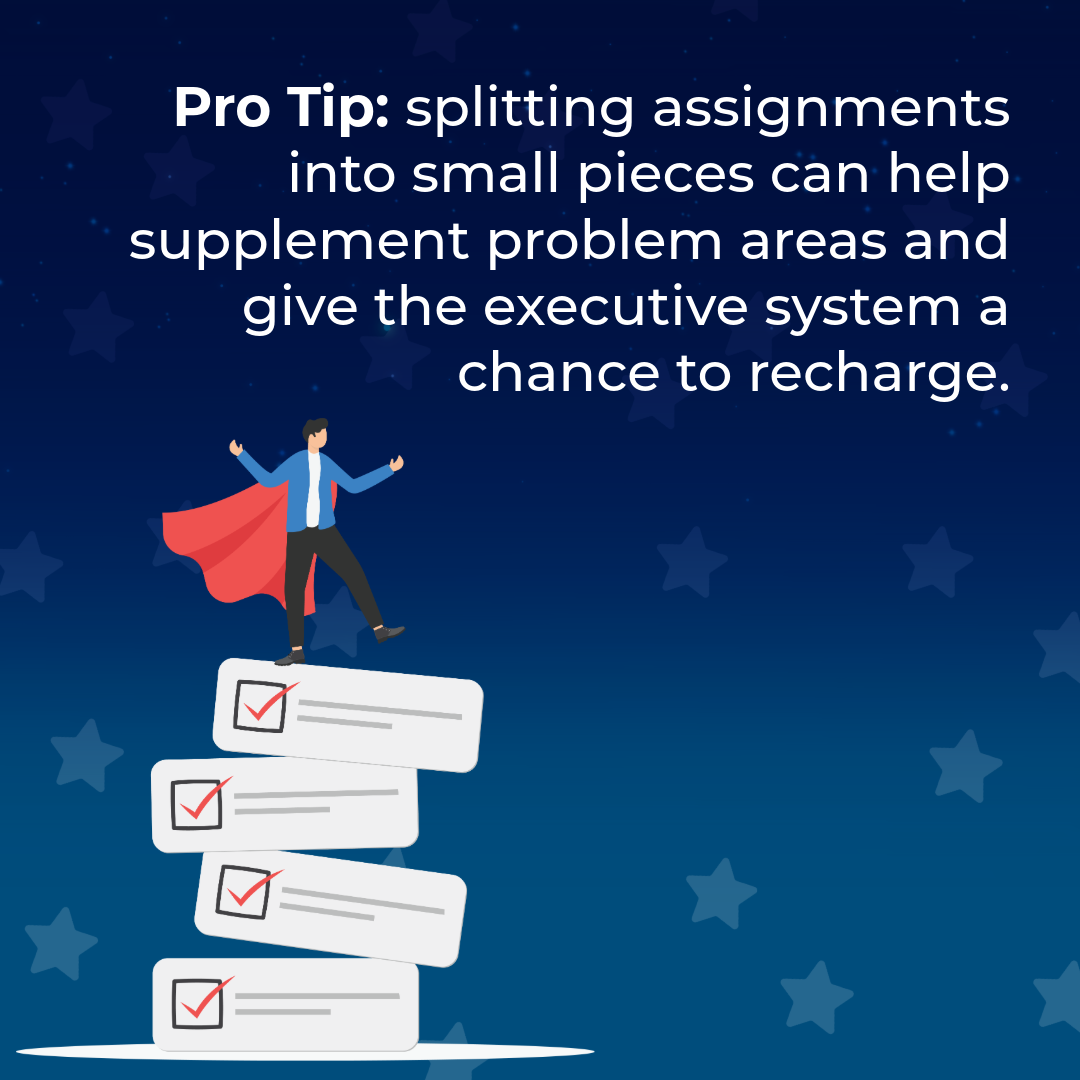
This helps every student, and it is close to essential for students who process differently. Learners with ADHD in particular tend to do far better with a large task split into small, concrete steps than with one undefined block labeled "schoolwork."
Don't Skip the Offline Breaks
The shorter school day tempts people into cutting breaks. Resist it. Screen-based learning asks for a lot of sustained attention, and breaks are not lost instructional time. They are the mechanism that makes the next block possible.
Northwestern Medicine notes that an effective daily routine does not need to be complicated. It needs a few consistent anchors, especially movement and real sleep. In practice:
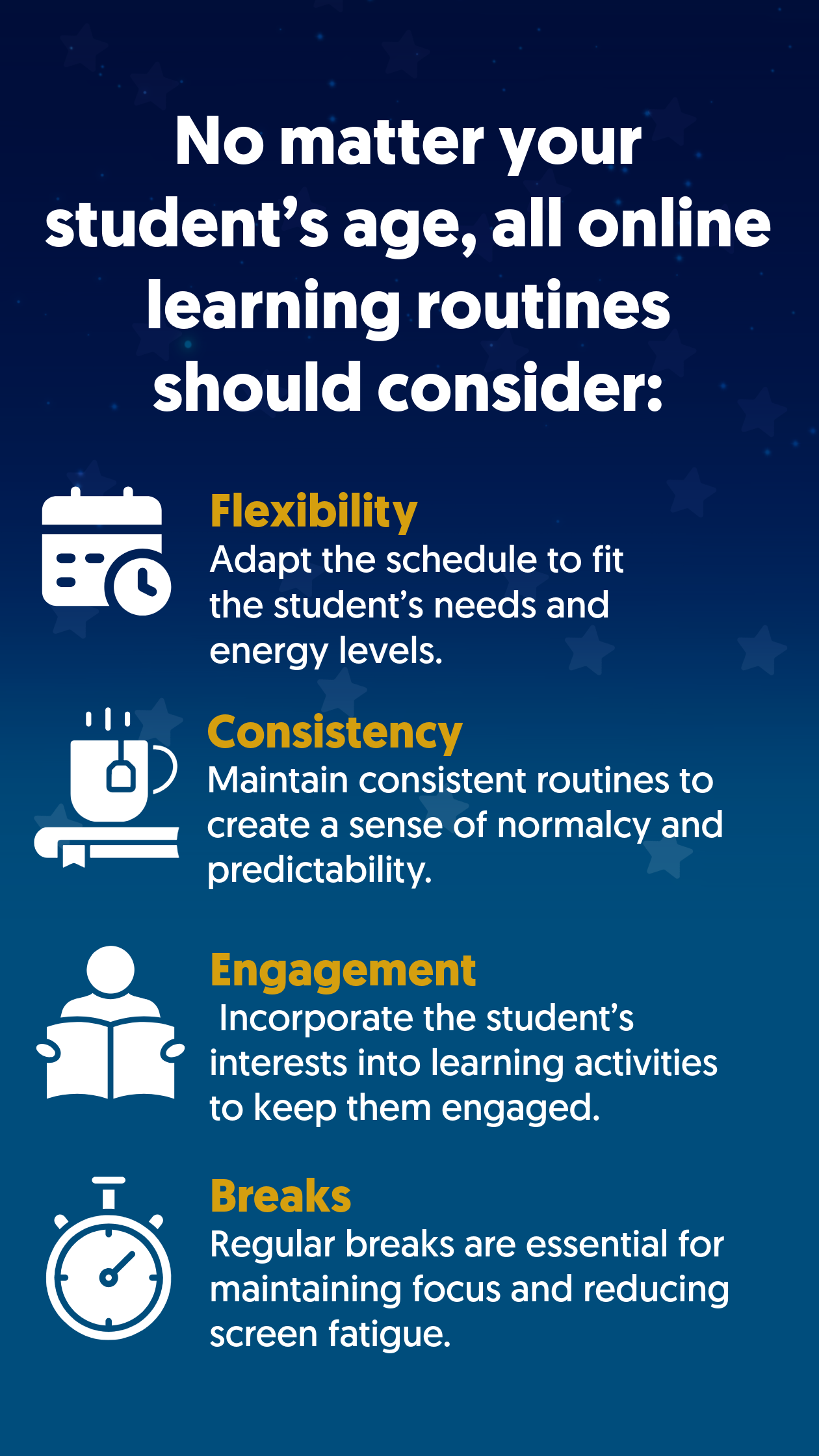
A short walk or a stretch between subjects
Morning sunlight soon after waking, which helps set energy and focus for the day
A consistent evening wind-down signal, which matters most before a testing day
Tennessee weather gives you a long usable outdoor season and one difficult stretch. Fall and spring make outdoor breaks easy, and it is worth taking full advantage while they last. Deep summer humidity and the short, gray days between December and February are the periods when outdoor movement quietly disappears from a family's routine. Planning an indoor alternative before you need one, whether that is a stretch routine, a few minutes of music, or a lap around the house, keeps the habit alive through the stretch when it is hardest to maintain.
Even a five-minute break is worth taking. A few deep breaths, a stretch, or naming a couple of things that went well is enough to lower stress and make it easier to re-enter focused work.

Build a Sample Schedule
Here is a starting template. Treat it as something to modify, not something to obey:
Morning: Wake, get outside for light and movement, breakfast
Mid-morning: Hardest subject or an optional live lesson
Late morning: Second focused independent work block
Midday: A real lunch break away from the screen
Early afternoon: Coursework and assignments in the second-best energy window
Late afternoon: Wind-down block for smaller tasks, review, or movement
Evening: Light review only if needed, then a consistent bedtime routine
Build the blocks around the energy your student actually has. A schedule everyone has quietly stopped following by Wednesday is not helping anybody.
Sample Schedules by Age Group
Tri Star serves students from kindergarten through high school. The same principles apply across all of them. What changes is block length and who is holding the reins.
Elementary school:
Work blocks of 20 to 30 minutes with movement in between
Live lessons clustered earlier, when focus is most available
Hands-on and offline activities woven between screen-based lessons
A visual, picture-based schedule rather than a written list
Middle school:
Blocks of 30 to 45 minutes, still broken up regularly
A mix of live lessons and independent work with clear start and stop times
The student increasingly running their own checklist, with a Learning Coach check-in once or twice a day
Extracurriculars and social time scheduled deliberately, not treated as an afterthought
High school:
Blocks of 45 to 60 minutes aligned to natural energy windows
Genuine ownership of the schedule by the student, with the Learning Coach shifting to a lighter check-in role
Protected time for test prep, projects, dual credit coursework, and career planning
Protected sleep, which is the thing high schoolers cut first and pay for hardest
What This Looks Like at Tri Star Virtual Schools
The asynchronous model is what makes any of this possible. Coursework is there when your student is ready for it, so the schedule can be built around real life instead of a bell.
A few pieces worth putting on the calendar deliberately:
Optional live lessons are your fixed anchors. Place them first, then arrange everything else around them.
One-on-one sessions and tutoring work best when scheduled ahead of a problem rather than in response to one. A standing slot in the hardest subject is a good default.
Your Success Specialist is with your family from enrollment through graduation and is the right person to bring in when the schedule keeps failing for reasons that are not obvious.
My Stellar Support holds login help, orientation walkthroughs, and progress tracking. Bookmark it in week one.
This is the practical version of School of One: the plan gets built around the student, and the daily schedule is one of the clearest places you can see that happening.
Frequently Asked Questions
What if my student's best focus time doesn't match the live lesson schedule?
Live lessons are fixed, independent work usually is not. Anchor the day to the live sessions and place the hardest independent work in your student's real energy window.
How long should a break actually be?
Five minutes is enough to be worth taking. Between major work blocks, 15 to 20 minutes works better, especially around the midday slump.
Should weekends follow the same structure?
Not exactly, but keeping wake and sleep times reasonably steady across the weekend makes Monday morning far less of a fight.
We're near the Central and Eastern time zone line. How should we handle live lesson times?
Confirm which zone a posted time refers to before you add it, then note the zone directly in your calendar entry. It takes ten seconds and saves at least one missed session a semester.
When the Schedule Falls Apart (Because It Will)
Something always goes sideways. An appointment, a rough night, a connection dropping in the middle of a live lesson. A good schedule bends without breaking. Build that in from the start:
Leave one buffer block per day. An unscheduled 30 to 45 minutes absorbs the unexpected without cascading into everything else.
Keep a "minimum viable day" ready. On the hardest days, know the two or three things that genuinely must happen.
Do not try to recover a whole lost day in one day. Spread makeup work across several days instead.
Revisit the schedule every couple of weeks. What worked in August rarely survives October unchanged.
Treat the schedule as a living document rather than a contract, and it stays useful instead of turning into one more thing to feel behind on.
Tools Worth Trying
A visible wall calendar or whiteboard, particularly for younger students who need to see the whole week at a glance
A shared digital calendar for older students and adult learners juggling live lessons, work, and independent deadlines
A kitchen or phone timer to mark the start and end of focus blocks without constant clock-checking
A two-minute end-of-day review covering what worked and what did not, which is how a schedule improves over the year instead of staying stuck
Consistency Beats Perfection
The strongest predictor of a schedule surviving the year is not how well it is designed. It is whether it is realistic enough to repeat without a fight. Give any new structure two full weeks before you decide it is wrong. Nearly every schedule needs a round of tweaking once real life gets a vote.
A day built with intention, one that respects your student's energy, sizes the work correctly, and protects real breaks, sets up a calmer and far more sustainable year.
Ready to build a school day that actually works for your family? Enroll Today
Questions? Our enrollment specialists are happy to help: Call Today!
Follow along for more scheduling tips all year: Facebook | Instagram | TikTok

Sources
LSBF, What Is the Best Time for Studying — Day or Night? lsbf.edu.sg
Northwestern Medicine, Healthy Habits to Strengthen Your Daily Routine. nm.org
ASU Prep Digital, Online Learning Routine. asuprepdigital.org
